NPS has got to be one of my favorite places to find deals. Any store that sells nuts and bolts by weight is alright in my book. The other day, I happened across a bunch of small 6-volt rechargeable AGM batteries. Most of them were priced at $1.08 each. I have walked by this isle many times before but for some reason, today, I got an epiphany!
“Why not buy 20 of these little guys and string them all together into a 120 volt battery pack?”
Not only would it be a useful test bed for repairing the controller in my electric truck, but I could also modify my electric lawn mower to run on this battery pack instead of the heavy 12 volt deep cycle battery it currently uses.
My electric lawn mower runs great, but it is really heavy and a huge workout pushing it around my ½ acre yard each week. It has a large 115Amp-Hour, 12 volt battery that powers an inverter, that converts the 12 volt DC up to 120 volts AC, which is then rectified to high voltage DC, which then powers a DC motor. Each conversion has some efficiency loss.
In order to provide enough power to cut a thick green lawn, the 12 Volt battery has to be able to deliver 80 Amps continuously. There is a phenomenon in all batteries called “The Peukert effect” which causes a large battery delivering a lot of amps to act like a lower capacity battery.
For example, If you have a 100 Amp-hour battery, it will provide 1 amp continuously for 100 hours. But if that same battery tried to deliver 100 amps for 1 hour, it wouldn't last for 1 hour like we had hoped. Because of the Peukert effect, it may only last 40 minutes or so depending on the battery chemistry and age of the battery. CURSE YOU PEUKERT EFFECT!!!
A power inverter is a marvelous invention that converts 12 volts DC to 120 volts AC. Like everything else in the universe, work comes at a price. The inverter used on my lawn mower has about a 5-15% efficiency loss involved in the conversion. When the battery is ½ discharged, and while under load, the voltage drops below 10.5 volts and the inverter goes into a low voltage alarm state, shutting itself down. I can still have enough capacity to mow my lawn using this battery, but it bothers me that I am pushing around an extra 20 lbs of lead with no way of extracting the energy out of it.
In addition to the small losses of the bridge rectifier, at 157 Volts, the rectified DC doesn't run the motor at it's top speed either.
By using a 120 Volt DC battery pack, the current draw from the battery will be in the 2 to 5 Amp range, not 60-90 Amps like with a 12 volt battery. Also, because the 120 Volt DC is true DC, and not rectified, unfiltered DC, the motor will run at its full speed.
When the pack starts to discharge, instead of shutting off completely, the motor just spins a little bit slower.
A few months ago, I discussed how reducing resistive losses in the battery-inverter wiring allowed an extra 15 minutes of run-time before the inverter would shut down. That worked great but it's time I take it a step further.
Before:
12 Volt 115Amp-Hour deep-cycle battery. 50.2 lbs (plus inverter and wire 3.4 lbs).
12 X 115 = 1380 Watt-hours, or about 13 cents worth of electricity.
After:
Twenty 6 Volt 4.5Amp-Hour AGM batteries. 32.4 lbs
20 X 6 X 4.5 = 540 Watt-hours, or about 5 cents worth of electricity.
Both designs mow the lawn just fine, but for a manually propelled lawn mower, the 21.2 pound weight loss is a night and day difference. By pushing around less weight, it takes me less time to mow my lawn. 1 hour 5 minutes down to ~52 minutes.
Sunday, August 28, 2011
Monday, August 22, 2011
EV Conversion Part 3 – Installing the Electric Motor:
It’s amazing to me how simple a job can become when you have the right tools, good lighting and room to work.
Mandatory tools for an EV conversion job:
- A place to perform the EV conversion, (for 200 hours or 2-6 months).
- Impact wrench with deep walled sockets
- Engine lift or cherry picker
- Arc welder
- Angle grinder
- Chop Saw with metal blade
- Drill press
- Paint sprayer
- Neoprene gloves x100 pair or more if you have OCD like me.
I bought a large DC electric motor and a generic adapter plate for connecting the motor to the transmission bell housing. I tested out the DC motor with a 12 volt battery to verify it works.
I lined up the motor with the adapter plate and clamped it in place.
Yeah, that kind of looks like blood but its spray paint from my first attempt at matching up the holes on the transmission bell housing. I drilled holes that matched my specific transmission.
I also had a shaft coupler machined that would match the shaft of the electric motor to the existing fly-wheel from the old engine. I still want the clutch intact for this EV conversion.
By grinding down a raspy metal file, I made a key for the motor shaft to lock into the coupler.
I used a couple extra hunks of metal from the old engine to secure the motor in place. I welded them to the motor and bolted them to the frame of the truck.
Wow! I now have a truck with an electric motor. I have to drive this around the block.
I connected up two 12-volt batteries in series and connected them to the motor with jumper cables. Using one end of a jumper cable for an instant on/off throttle control, ZAP, the truck came to life!
I drove it down the street a few of times at the screaming speed of 10mph. Check out this video clip of me test driving it here.
I really need to get more batteries and install the motor controller. Eventually this truck will drive at freeway speeds.
Thursday, August 18, 2011
EV Conversion Part 2 – Making it look nice:
After I pulled out all the parts from the internal combustion engine, I took a good look at the truck carcass that remained. It was dirty, rusty and kind of ugly. Since I was making such a large investment in a vehicle that I will be driving for the next 5-10 years, I decided to spend some extra time and make it look nice.
I washed off all the grease, pulled off the bed, sanded down the frame and primed all bare and rusty metal.
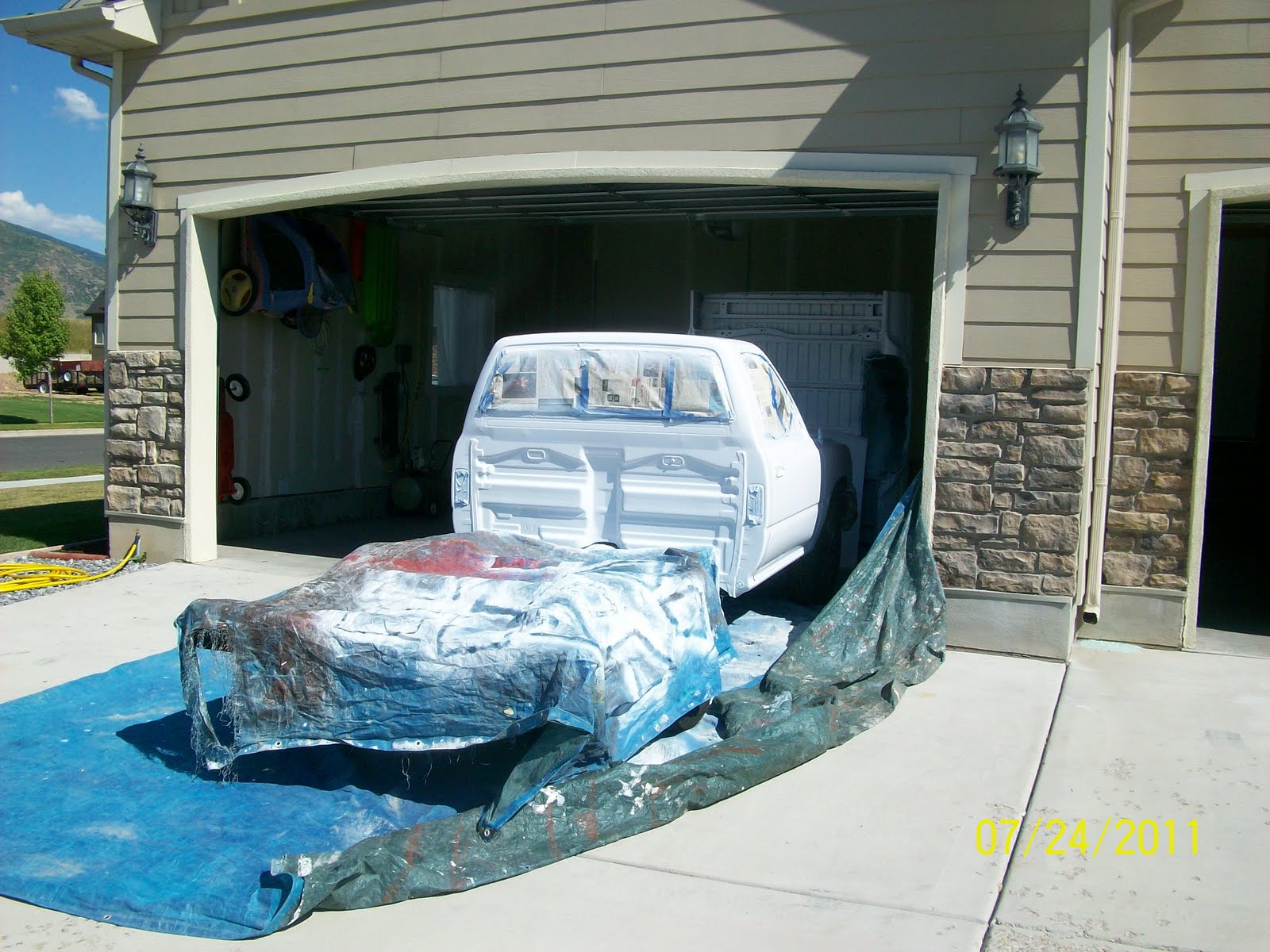
After that, I painted the frame a shiny black color. Once that paint had cured, I taped off all the glass and painted the truck with an air sprayer. It took 2 hours to tape everything off and only 15 minutes to spray the paint on.
I’m no expert in auto body paint but the paint job turned out very nice.
It was so easy, (relatively) that I now want to re-paint my 1992 Honda Accord.
They have so many wonderful hues and colors of paint now days. I believe the color of my car is called, “Fading, cracking vomit.” I’m going to re-paint it “Tree Hugger” green.
I washed off all the grease, pulled off the bed, sanded down the frame and primed all bare and rusty metal.
After that, I painted the frame a shiny black color. Once that paint had cured, I taped off all the glass and painted the truck with an air sprayer. It took 2 hours to tape everything off and only 15 minutes to spray the paint on.
I’m no expert in auto body paint but the paint job turned out very nice.
It was so easy, (relatively) that I now want to re-paint my 1992 Honda Accord.
They have so many wonderful hues and colors of paint now days. I believe the color of my car is called, “Fading, cracking vomit.” I’m going to re-paint it “Tree Hugger” green.
Wednesday, August 17, 2011
Electric Car Conversion Part 1 – The Donor Vehicle and The ICE Removal:
In 2008, I bought an old Geo Metro for $1 for the purpose of converting it to an all electric car. I calculated it would have a 40 mile range and only cost me $3000 in parts. It would be the perfect commuter car, requiring only $0.67 cents in electric fuel to get me back and forth to work each day.
A Geo Metro has a light frame but has little room for extra weight. A pickup truck is relatively lightweight but has a stronger frame that can handle additional battery weight.
Unfortunately, my enthusiasm for the project faded when we moved to another house out of the range of the car's design.
Fast Forward 3 years:
My desire for an Electric Vehicle was rekindled by the announcement of the Nissan Leaf. But after nearly a year sitting on the waiting list, I opted to roll my own, again.
I have read that the an electric vehicle will have greater range if it can carry more batteries. It makes sense. More fuel = more range.
A Geo Metro has a light frame but has little room for extra weight. A pickup truck is relatively lightweight but has a stronger frame that can handle additional battery weight.
In June 2011, I acquired a 1992 Toyota Pickup Truck. Although the mileage was high, it was in good cosmetic condition.
I ripped out all the “unnecessary” parts. The internal combustion engine, radiator, gas tank and the exhaust system.
This lightened the truck weight by 500 lbs and freed up a lot of room in the engine compartment for an electric motor and batteries.
Monday, July 25, 2011
How to save energy running your central A/C
Isn't central A/C wonderful? Its so cool and comfortable but on the other hand, so darn expensive.
Central Air Conditioner Coil Shade:
Central Air Conditioner Misting System:
To cool the outside air temperature, I originally thought of building a swamp cooler around the central A/C unit outside. That cost estimate quickly rocketed up into the $400 range. I'm all for advancing science and mankind's well-being but I don't want to blow that much money this early in the game.
Notice how the air conditioner has shorter duty cycles on the day the attic fan is running.
My last house had an evaporative cooler on the roof. It's basically a system that draws hot, dry air through water soaked pads. The heat in the air is absorbed when the water evaporates. Hot, dry air goes in and cool, more humid air comes out. When the humidity is low, it works beautifully. When it's muggy outside, well, that's where the evaporative cooler gets it's “swamp” nickname. In a dry climate like Utah, the swamp cooler is extremely efficient, somewhere on the order of 48 SEER. A typical central A/C is only 10-18 SEER.
Psychometric chart
A properly tuned and maintained swamp cooler will produce air that is a couple degrees above the wet-bulb temperature. So if it's 110 °F outside with only 10% humidity, the wet-bulb temperature will be 68 °F and the air coming out of the swamp cooler will be about 71°F. Not a bad system for a really dry climate.
A few weeks ago, I was pondering the idea of combining a central A/C with a swamp cooler. They do it all the time in the chillers on large commercial air conditioning systems. Why don't A/C manufactures offer it in their products to homeowners?
After a few hours reading on the home HVAC installer forums, I learned that people who ask this question, “Why not wet down a central A/C?” are flogged and burned at the stake so to speak.
Evaporating lots of water on thin metal cooling fins is the quickest way to rust and corrode them. A modest savings of power up front will end up costing the homeowner a new A/C unit in a few years.
Being an exceedingly curious man, I just can't put the issue to bed that easily. Yes, I can see how wetting down cooling fins with hard water is just asking for trouble, not to mention increased maintenance and the potential for flooding problems. But I believe that under the stretched out tent walls of a generalized bad idea lie stringent ruled, brilliant ideas.
To protect the uneducated public from injury and damage, an idea that is dangerous some of the time is stereotyped as a bad idea all the time.
For example, “Never put metal in the microwave”. Now this might seem like good advice to follow because we have all been raised to believe it is true in all cases; that it is dangerous to put metal in the microwave.
But you forget that microwave ovens are made of metal. Some microwave ovens even come with metal shelves and metal temperature probes. “No metal in the microwave oven” is a contradiction. The more correct statement should be, “Never put metal in the microwave oven when the dielectric properties and electrical dimensions of the metal and food pieces will cause excessive heating and current flow across the metal.” To simplify our lives by not having to crunch a bunch of energy density functions and calculations each time you need to re-heat something, it is generally easier just to not put any metal in the microwave oven.
There will always be exceptions to rules and contradictory exceptions to those exceptions.
FYI#1:You can defrost an open can of juice concentrate in the microwave oven, even though the bottom of the can is made of metal.
FYI#2: Re-heating in a microwave oven an Arby's roast beef sandwich shrouded in its metal lined paper wrapping will cause it to catch fire. Right Marv?
Just as with exceptions to the "no metal in the microwave" rule, I believe that under the right circumstances, cooling the A/C coils with water (softened water) is a good idea and will save energy without significantly shortening the life of the A/C system itself. If I am wrong, I get to buy a more energy efficient A/C coil to replace the one I currently have.
It is my goal to confirm the following statements:
- Removing direct sunlight by shading the outside A/C coil (without limiting airflow) will lower the power consumption of the compressor during those hours of direct sun-light.
- Lowering the temperature of the air conditioner coils (outside unit) will lower coolant pressure, lower compressor current draw and make the A/C run more efficiently.
- Adding powered attic ventilation in a properly air sealed home will make the central air conditioner run less and reduce overall power consumption.
I know that doing the above steps could potentially save energy. How much? Well, that's where experimenting comes in.
My house is already pretty well insulated. I also air sealed major air penetration areas of the home, (recessed lights, plug sockets, windows) and added more passive attic ventilation. These low lying, energy saving fruits are already harvested.
Central Air Conditioner Coil Shade:
Using my TED house power monitoring system, I noticed that between the hours of 5-8PM, the duty cycle of the air conditioner goes way up. I also noticed that it was during those same hours that the setting sun is beating down on the air conditioner unit outside.
I decided to build a shade to see if that would improve anything.
To my surprise, with the tarp shade, the power consumption of the air conditioner while it was running did not change much but the duty cycle of the air conditioner's "on" cycle, shortened.
That worked so well that I spent $100 on a couple sheets of grey PVC lattis and channel pieces. I built a more permanent trellis shade that looks nice and still shortens the A/C duty cycle during the evening sun hours.
This shade results in a 1.9KWH/day air conditioner energy savings with the added benefit of looking less like a crime scene than the tarp.
Central Air Conditioner Misting System:
To cool the outside air temperature, I originally thought of building a swamp cooler around the central A/C unit outside. That cost estimate quickly rocketed up into the $400 range. I'm all for advancing science and mankind's well-being but I don't want to blow that much money this early in the game.
I ended up going with a simple misting design (with 15-20 misting heads) that would allow for more airflow to the A/C coils. There are products on the web that do just that for about $100, but they are for smaller A/C units and adding enough misters for my size A/C unit add up to over $200. Plus I didn't like the toilet flapper float design they used for turning on and off the water supply line.
For about $45 I built my own misting system that uses an electronic sprinkler valve controlled by the existing HVAC thermostat.
The water feeds through from an unused hose bib near by into the sprinkler valve.
How cool and and refreshing is that?
The misting system reduces the outside air temperature, in turn reducing the pressure of the whole system, in turn reducing the air conditioner's power consumption 850 watts (or 21%) while it is running its cooling cycle. This results in a 4.8KWH/day air conditioner energy savings.
I still need to run a soft water line out to the misting system, before the A/C coil is sentenced to a corroded, rusty fate.
Attic Fans:
I still need to run a soft water line out to the misting system, before the A/C coil is sentenced to a corroded, rusty fate.
Attic Fans:
A couple of years ago, I installed a thermostat controlled attic fan. I had read that venting out the heat in the attic will reduce cooling costs, (makes sense). But it also takes energy to spin a large fan for 10 hours every day.
If the house isn't properly air sealed, cool conditioned air from the house will be sucked into the attic space and vented outside. In this case, the central air conditioner will use more energy with an attic fan running.
If the attic is far under ventilated, the attic fan will not be able to draw out enough hot air to make a difference but still draw a lot of power.
If the attic has superior ventilation (most homes, including mine don't), an attic fan will not do any good either because the attic vents are already doing the an attic fan's job only passively.
Ever since I air-sealed my home, I have been wanting to quantify the attic fan's performance and usefulness. I got the chance this weekend when my entire family was away and left me home alone. No stoves cooking, no kids leaving outside doors open, no TV's being left on. Just a relatively constant, measurable whole house power consumption. To help in comparing apples to apples, the weather forecast all weekend was sunny and in the low 90's .
I ran one day with the attic fan on and one day with it off.
Notice how the air conditioner has shorter duty cycles on the day the attic fan is running.
All things being equal and even with R-38 insulation in the attic, the attic fan lowered the central air conditioner's power consumption by 20%.
Even though my attic fan draws 190 watts when it is running (190x10hrs/day = 1.9KWH), it actually reduced the central A/C usage by 6.6KWH for a net gain of 4.7KWH.
After operating for 2 summer seasons and at an electrical savings of $70/ season, my attic fan just paid for itself last year.
Even though my attic fan draws 190 watts when it is running (190x10hrs/day = 1.9KWH), it actually reduced the central A/C usage by 6.6KWH for a net gain of 4.7KWH.
After operating for 2 summer seasons and at an electrical savings of $70/ season, my attic fan just paid for itself last year.
Between the A/C trellis shade (1.9KWH savings), the A/C misting system (4.8KWH savings) and the attic fan (4.7KWH savings), my whole house net energy savings is 11.4KWH/day or a 22% reduction. COOL!
Shoot, with the energy saved by not using an extra 11.4KWH/day all summer long, I could drive an electric vehicle 3420 miles, or commute in it to work for 5 months, FOR FREE!
Update 7/27/2011:
I have since plumbed my hose bib to the soft water line. Now the misting system will not corrode the coil nearly as fast; maybe not at all.
Update 7/27/2011:
I have since plumbed my hose bib to the soft water line. Now the misting system will not corrode the coil nearly as fast; maybe not at all.
Thursday, June 23, 2011
Water Conservation:
I live in the desert landscape of the Wasatch front in northern Utah. I say desert because that is what it used to be when the Mormon pioneers settled here almost 164 years ago. When they arrived, the Prophet and leader Brigham Young proclaimed, “This is the place!” I wonder if this was actually a question and not a statement? Perhaps he really meant, “This is the place?”
Either way, those early Mormon pioneers took a dry piece of desert land and transform it into a fruitful, lush, green oasis. Today over 2 million people live here and it is a beautiful, green, mountainous landscape.
We all have to start being more conservative if we expect to sustain our American lifestyle on such a finite water resource. It is possible for all of us and our children to have luxuries and amenities. We just have to be smart with how we use our resources.
Use low-flow shower heads:
This is good practice but you can even take it a step further. Hop in the shower, get wet, rinse off, then turn off water. At this point, take your time lathering up and scrubbing yourself clean. When done, turn the water back on and rinse off. You will only use 3-8 gallons for your shower. Without the water washing the soap away before it has had a chance to do its job, you will get cleaner and use less soap in the process.
Drain Water Heat Recovery:
It takes a lot of energy to heat water. It's a shame that all that energy ends up going down the drain.
By using a Heat-recovery drain pipe, one can recover 80-90% of that wasted energy. When water runs down a vertical pipe, rather than falling down the center very quickly, it glides down the inside wall of the pipe. In a heat recovery drain, a section of vertical sewer pipe is replaced with a thermally conductive copper one, a smaller copper culinary water pipe is wrapped around the copper sewer pipe. In this manner, heat from warm waste water (and nothing else) is transferred to the cold water on its way to the water heater. A typical system costs about $500-$800 and the pay off ranges from 2-7 years depending on how much you use it. Heat from shower water is easily reclaimed because there is a continual flow of warm waste water preheating the continual flow of cold water entering the water heater. I want to install one of these someday.
Use an efficient washing machine:
Spend a little extra up front and save a bunch throughout the life of the appliance. Energy Efficient washing machines will save you thousands of gallons of water each year and reduce the energy consumed drying clothes because they spin clothes faster making them drier.
I recently replaced my old washing machine and electric clothes drier with an energy efficient, front loading washing machine and a gas drier. My electric bill went down 120KWH/month by drying 8 loads/week with gas instead of electricity. But to my surprise, my gas bill also went down. Even though my clothes drier now runs on natural gas, the washing machine uses so little water now (2.2 gallons/load) that the water heater doesn't have to heat up nearly as much water to feed the washing machine. The result is a net reduction in electricity and natural gas consumption.
Fix drippy faucets and running toilets:
A drippy faucet can annoy the crap out of you and also wastes 20-100 gallons of water in a day. Leaky hot water wastes energy too because your water heater has to heat up all that water before it gets lost.
Saving Water Around the Yard:
I am not very stringent in this area. I own a large ½ acre lot, that is mostly lawn. Kentucky Bluegrass is not native to arid Utah. It takes a lot of water to keep it green and happy. But that is what the cavalier American dream demands, right? A lush, manicured, green lawn? You have to admit though, it does look pretty good.
It also feels good walking barefoot or laying down on a healthy green lawn. The kids love to play on it too. Even for an energy sipping tree-hugger like myself, I justified putting it in. My wife may have twisted my arm a little bit.
I read on the Internet that an acre of grass sequesters 3 tons of CO2 each year. There is a lot of research ongoing regarding this topic. The sequestration numbers vary from several tons of CO2 per acre per year to lawns actually being a net carbon source.
Even with my property having a large irrigation water share, I still hate to see any of it going to waste.
If you have a choice, buy a house that has secondary water for watering the yard. Living in Utah, I am baffled why most homes here only have a culinary water supply. It's expensive to water a large lawn with culinary water, not to mention a terrible waste of a limited resource.
Regardless of the water source, water the lawn in the early morning to limit evaporation. Make sure sprinkler heads are in good repair and automatic sprinkler valves turn on and off correctly. In my last house, I only had culinary water. I had a sprinkler zone dedicated to watering several strawberry plants. One day, the valve got stuck in the on position. I didn't notice it until after returning from a vacation. Needless to say, the strawberries were amazing, but not as amazing as my water bill.
Only water the lawn from a couple times a week to every other day. When you do water, give the lawn a good soaking, then allow the ground to dry out for a few days. This promotes a healthier lawn by sending the roots deep in search of water. Deep roots enable the plant to go longer between watering intervals.
Collect rain water for use later in the year:
Why pay for water when mother nature already gives you the water for free? Acquire a large cistern that can collect snow melt and rain water from the roof. During the summer months when it is dry, this water can be conservatively issued to the plants in the yard.
Xeriscape yard:
Only plant native plants in the yard that thrive solely off of the natural water cycle. No irrigation is required.
Check out your local water conservation district. They have examples and ideas of yard landscapes that will work in your local geography.
Drink Water:
Anyone else thirsty? Don't buy a Coke! Drink water!! Fill up a bottle from home and drink up. It's free!
Milk is for Graham Crackers. Juice is for special occasions. Water is great anytime.
Either way, those early Mormon pioneers took a dry piece of desert land and transform it into a fruitful, lush, green oasis. Today over 2 million people live here and it is a beautiful, green, mountainous landscape.
We all have to start being more conservative if we expect to sustain our American lifestyle on such a finite water resource. It is possible for all of us and our children to have luxuries and amenities. We just have to be smart with how we use our resources.
Use low-flow shower heads:
This is good practice but you can even take it a step further. Hop in the shower, get wet, rinse off, then turn off water. At this point, take your time lathering up and scrubbing yourself clean. When done, turn the water back on and rinse off. You will only use 3-8 gallons for your shower. Without the water washing the soap away before it has had a chance to do its job, you will get cleaner and use less soap in the process.
Drain Water Heat Recovery:
It takes a lot of energy to heat water. It's a shame that all that energy ends up going down the drain.
By using a Heat-recovery drain pipe, one can recover 80-90% of that wasted energy. When water runs down a vertical pipe, rather than falling down the center very quickly, it glides down the inside wall of the pipe. In a heat recovery drain, a section of vertical sewer pipe is replaced with a thermally conductive copper one, a smaller copper culinary water pipe is wrapped around the copper sewer pipe. In this manner, heat from warm waste water (and nothing else) is transferred to the cold water on its way to the water heater. A typical system costs about $500-$800 and the pay off ranges from 2-7 years depending on how much you use it. Heat from shower water is easily reclaimed because there is a continual flow of warm waste water preheating the continual flow of cold water entering the water heater. I want to install one of these someday.
Use an efficient washing machine:
Spend a little extra up front and save a bunch throughout the life of the appliance. Energy Efficient washing machines will save you thousands of gallons of water each year and reduce the energy consumed drying clothes because they spin clothes faster making them drier.
I recently replaced my old washing machine and electric clothes drier with an energy efficient, front loading washing machine and a gas drier. My electric bill went down 120KWH/month by drying 8 loads/week with gas instead of electricity. But to my surprise, my gas bill also went down. Even though my clothes drier now runs on natural gas, the washing machine uses so little water now (2.2 gallons/load) that the water heater doesn't have to heat up nearly as much water to feed the washing machine. The result is a net reduction in electricity and natural gas consumption.
Fix drippy faucets and running toilets:
A drippy faucet can annoy the crap out of you and also wastes 20-100 gallons of water in a day. Leaky hot water wastes energy too because your water heater has to heat up all that water before it gets lost.
Saving Water Around the Yard:
I am not very stringent in this area. I own a large ½ acre lot, that is mostly lawn. Kentucky Bluegrass is not native to arid Utah. It takes a lot of water to keep it green and happy. But that is what the cavalier American dream demands, right? A lush, manicured, green lawn? You have to admit though, it does look pretty good.
It also feels good walking barefoot or laying down on a healthy green lawn. The kids love to play on it too. Even for an energy sipping tree-hugger like myself, I justified putting it in. My wife may have twisted my arm a little bit.
I read on the Internet that an acre of grass sequesters 3 tons of CO2 each year. There is a lot of research ongoing regarding this topic. The sequestration numbers vary from several tons of CO2 per acre per year to lawns actually being a net carbon source.
Even with my property having a large irrigation water share, I still hate to see any of it going to waste.
If you have a choice, buy a house that has secondary water for watering the yard. Living in Utah, I am baffled why most homes here only have a culinary water supply. It's expensive to water a large lawn with culinary water, not to mention a terrible waste of a limited resource.
Regardless of the water source, water the lawn in the early morning to limit evaporation. Make sure sprinkler heads are in good repair and automatic sprinkler valves turn on and off correctly. In my last house, I only had culinary water. I had a sprinkler zone dedicated to watering several strawberry plants. One day, the valve got stuck in the on position. I didn't notice it until after returning from a vacation. Needless to say, the strawberries were amazing, but not as amazing as my water bill.
Only water the lawn from a couple times a week to every other day. When you do water, give the lawn a good soaking, then allow the ground to dry out for a few days. This promotes a healthier lawn by sending the roots deep in search of water. Deep roots enable the plant to go longer between watering intervals.
Collect rain water for use later in the year:
Why pay for water when mother nature already gives you the water for free? Acquire a large cistern that can collect snow melt and rain water from the roof. During the summer months when it is dry, this water can be conservatively issued to the plants in the yard.
Xeriscape yard:
Only plant native plants in the yard that thrive solely off of the natural water cycle. No irrigation is required.
Check out your local water conservation district. They have examples and ideas of yard landscapes that will work in your local geography.
Drink Water:
Anyone else thirsty? Don't buy a Coke! Drink water!! Fill up a bottle from home and drink up. It's free!
Milk is for Graham Crackers. Juice is for special occasions. Water is great anytime.
Friday, June 3, 2011
Solar Panels 6 Months Later
It has been over 6 months since I installed solar panels and started making my own electricity.
Even though solar panels are more efficient at making power when they are cold, having less hours of the day really hurts production.
January more than doubled December's production with 380kwh. February almost doubled it again and nearly zeroed out the net meter. March was the first month where production equaled consumption. Even with all the record rain fall and cloudy weather in Northern Utah, the months of April and May produced enough power to run my house for 3 months. I can't wait to see production on months where it doesn't rain every day. This unseasonably cold weather and cloudy skies hampered available solar energy but at the same time, I hardly had to turn on the air conditioner.
I am currently producing twice the energy of what I consume. On a sunny day, I make over 3X.
My utility company allows me to build up a one-for-one credit with them so long as I use up that credit within 12 months of accruing it. Under this system, the grid is effectively my battery. A non-volatile, unlimited capacity, low cost, maintenance free battery. All I pay is the $5/month fee, well worth the price in my opinion. The electric company lets me do this because I am helping them reduce their peak demand. Solar panels are the perfect solution to preventing rolling blackouts.
As of today, I have built up nearly 2 months worth of energy credit.
In hindsight, a 6.2Kilowatt solar system is a little too large for powering just my house. But when I first looked into getting solar panels, my energy consumption was much higher than it is now. An un-calculated side effect of having solar power (and a TED whole house monitoring system) is a lifestyle change. Having a device that points out to you that you are being extremely wasteful will change the way you act and think forever.
Charge an electric car
To recap, December was not a good month for solar energy. My panels only made 160kwh all month and I used 310kwh more than I made. Just by looking at daily solar panel production for December, you can extrapolate when the winter solstice took place (TED started collecting data on December 4th).
Even though solar panels are more efficient at making power when they are cold, having less hours of the day really hurts production.
January more than doubled December's production with 380kwh. February almost doubled it again and nearly zeroed out the net meter. March was the first month where production equaled consumption. Even with all the record rain fall and cloudy weather in Northern Utah, the months of April and May produced enough power to run my house for 3 months. I can't wait to see production on months where it doesn't rain every day. This unseasonably cold weather and cloudy skies hampered available solar energy but at the same time, I hardly had to turn on the air conditioner.
I am currently producing twice the energy of what I consume. On a sunny day, I make over 3X.
My utility company allows me to build up a one-for-one credit with them so long as I use up that credit within 12 months of accruing it. Under this system, the grid is effectively my battery. A non-volatile, unlimited capacity, low cost, maintenance free battery. All I pay is the $5/month fee, well worth the price in my opinion. The electric company lets me do this because I am helping them reduce their peak demand. Solar panels are the perfect solution to preventing rolling blackouts.
As of today, I have built up nearly 2 months worth of energy credit.
In hindsight, a 6.2Kilowatt solar system is a little too large for powering just my house. But when I first looked into getting solar panels, my energy consumption was much higher than it is now. An un-calculated side effect of having solar power (and a TED whole house monitoring system) is a lifestyle change. Having a device that points out to you that you are being extremely wasteful will change the way you act and think forever.
This increased awareness has indirectly reduced my energy consumption by 1/3rd. All the while, my standard of living has remained the same or even increased.
Now that I am making more energy than I will use in a year, I need to put it to good use before I have to give it away for free, which isn't exactly the end of the world either -- actually I would be saving the world then wouldn't I. Here are a few ideas.
Make some hydrogen
Make some hydrogen
Using electricity, one can split water molecules into oxygen and hydrogen. Storing hydrogen is tricky because it takes a lot of space and doesn't have a very high energy density. But once you have it stored in tanks, you could then use it to power a fuel cell and generate electricity during a power outage. Or you could burn it directly for cooking or heating.
Heat the home in the winter months
A deca-therm of natural gas is equivalent to 293KWH. Heating my home for the winter (using an electric furnace instead of natural gas) would require 16,500KWH. I would need a solar system nearly twice as large as what I have now just to run the furnace for the winter. This would be a stupidly inefficient way to heat a house. Still, if I have energy to burn, why not? Nah.
Charge an electric car
Charging an electric Chevy S-10 pickup truck after driving it 40 miles will require somewhere in the neighborhood of 9KWH of electricity. I drive my current commuter car about 8000 miles a year. That works out to only needing 1800KWH/year. That would be perfectly doable with my estimated surplus and save me about $820 in gas each year. This would also knock the return on investment for the solar system down from 6 years to just over 3 years. Hmmmm.
Power a Time Machine
Too cliche. By the way, a few years from now, I actually invented a time machine and went back in time to a few hours from now. Apparently, it didn't go very well and an even older version of myself had to go back in time to a few minutes ago and stop the whole event from taking place. Time travel is tricky like that, not to mention it takes a ton of power and the stupid machine kept blowing the main breaker.
Time travel, Shmime travel, I just want a microwave oven clock that doesn't have to be reset each time the power goes out.
Power a Time Machine
Too cliche. By the way, a few years from now, I actually invented a time machine and went back in time to a few hours from now. Apparently, it didn't go very well and an even older version of myself had to go back in time to a few minutes ago and stop the whole event from taking place. Time travel is tricky like that, not to mention it takes a ton of power and the stupid machine kept blowing the main breaker.
Time travel, Shmime travel, I just want a microwave oven clock that doesn't have to be reset each time the power goes out.
Subscribe to:
Posts (Atom)